
AI Case Studies
Creatives are right to be a little suspicious of AI. Too often, “AI-powered creative” is just a nicer way of saying faster, cheaper, and noticeably worse.
I’m more interested in what happens when AI takes on the work around the work. Great creative teams lose a surprising amount of time answering vague requests in Slack, hunting down old files, sorting through feedback, and deciding which projects actually deserve custom support. None of that requires less judgment. It just requires a better system.
AI voice can solve a different, but equally common, problem. Startups often scale faster on the product side than their marketing budgets can keep up. They still need polished product storytelling, but may not have the budget for professional talent across every cut, audience, and script variation. At Guild, synthetic voice made it possible to produce dozens of tailored videos we otherwise could not have afforded, while still giving me control over tone, pacing, pronunciation, and performance.
The two case studies below show how I’ve used AI to help a lean team operate more intelligently and scale production without lowering the bar.
(No AI slop or six-fingered hands involved.)
Scaling Creative Operations with Agents
Scaling Product Storytelling with AI Voice
CASE STUDY
Scaling Creative Operations with AI
The Challenge
At HubSpot, I worked within a large creative organization supported by dedicated project managers and creative operations teams. When I moved to Guild, I joined a creative team of four without that same operational support.
All incoming creative requests required my direct involvement. A slack ping from a product marketer, an email from a sales rep, an Asana request from the brand team.
But the challenge was not simply managing tasks. With only two full-time designers, every request had an opportunity cost. I was responsible for clarifying requirements, pressure-testing urgency, evaluating business impact, searching for similar past work, and determining whether a request warranted custom creative support or could be solved another way.
This upfront admin work was necessary, but the more time I spent managing intake and routing requests, the less time I had to focus on the parts of my role that truly require creative expertise: strategy, storytelling, and craft.

The Idea
What if we could design an AI-powered intake and prioritization agent that could manage the first stage of the creative request process?
Rather than slacking the Creative Director the details of a request, stakeholders would have a guided conversation with the agent. It would ask the same questions a strong creative operations partner would ask:
What business outcome does this support?
What is driving the deadline?
Is the requested date fixed or preferred?
Who is the audience?
Does the request generate revenue, support a major company priority, or address a meaningful customer need?
Based on the answers, the agent could recommend the appropriate path: hands-on support from the creative team, reuse of an existing, similar asset, or a self-serve solution.
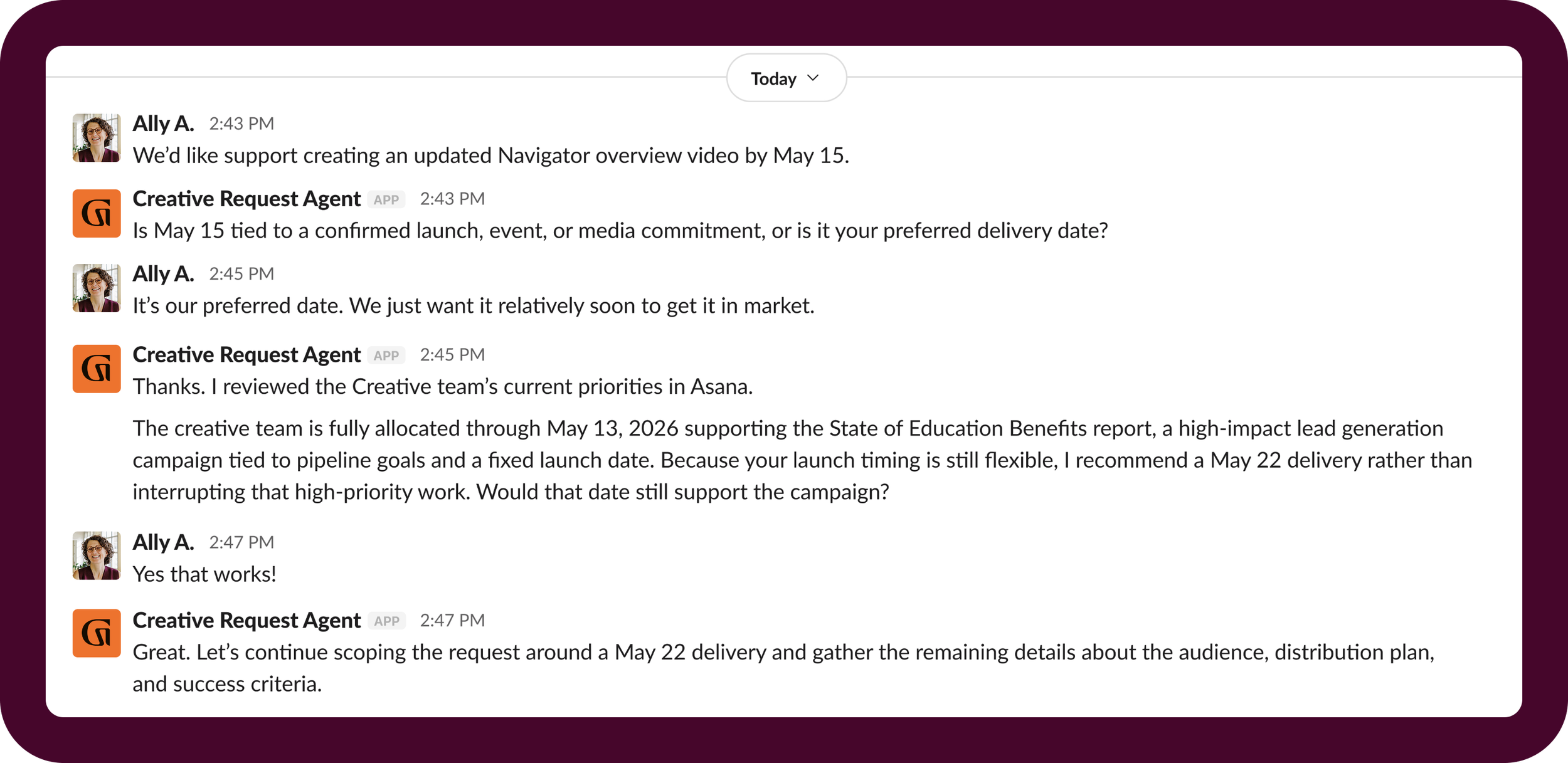
Conversational Scoping: The agent interrogates vague requests, asks strategic follow-up questions, and separates fixed launch dates from preferred ones.
Example: A marketer requested an overview video by May 15, which conflicted with ongoing project timelines. The agent asked follow-up questions about the deadline, and discovered it was flexible. This allowed the team to finish existing, in-flight work before pivoting onto this project.
Project Goals
Protect creative time
Use AI first on administrative work that distracts from strategy and craft.
Make prioritization consistent
Apply the same business criteria to every request, regardless of who submitted it.
Reuse before recreating
Treat the existing creative library as an active source of solutions, not an archive.
Keep humans in high-value decisions
AI can recommend, route, and summarize. Creative leaders still make judgment calls on sensitive, strategic, or ambiguous work.
Create clarity without creating friction
The interaction should feel like a helpful creative partner, not a bureaucratic approval process.
Impact
The concept was designed to reduce manual intake and follow-up, increase reuse of existing creative, redirect low-priority work toward self-service, and protect the team’s limited capacity for the projects most likely to move the business forward. It reflects my broader approach to AI in creative organizations: automate the work that keeps creative people from being creative, not the thinking and craft that make their work valuable.
The project also represented a challenge to traditional assumptions around implementing AI in creative workflows. Creative teams can adopt AI without defaulting to AI slop flyers and uncanny photography. AI can be a powerful to free up creative’s time to focus on creating better, more human-centered art.
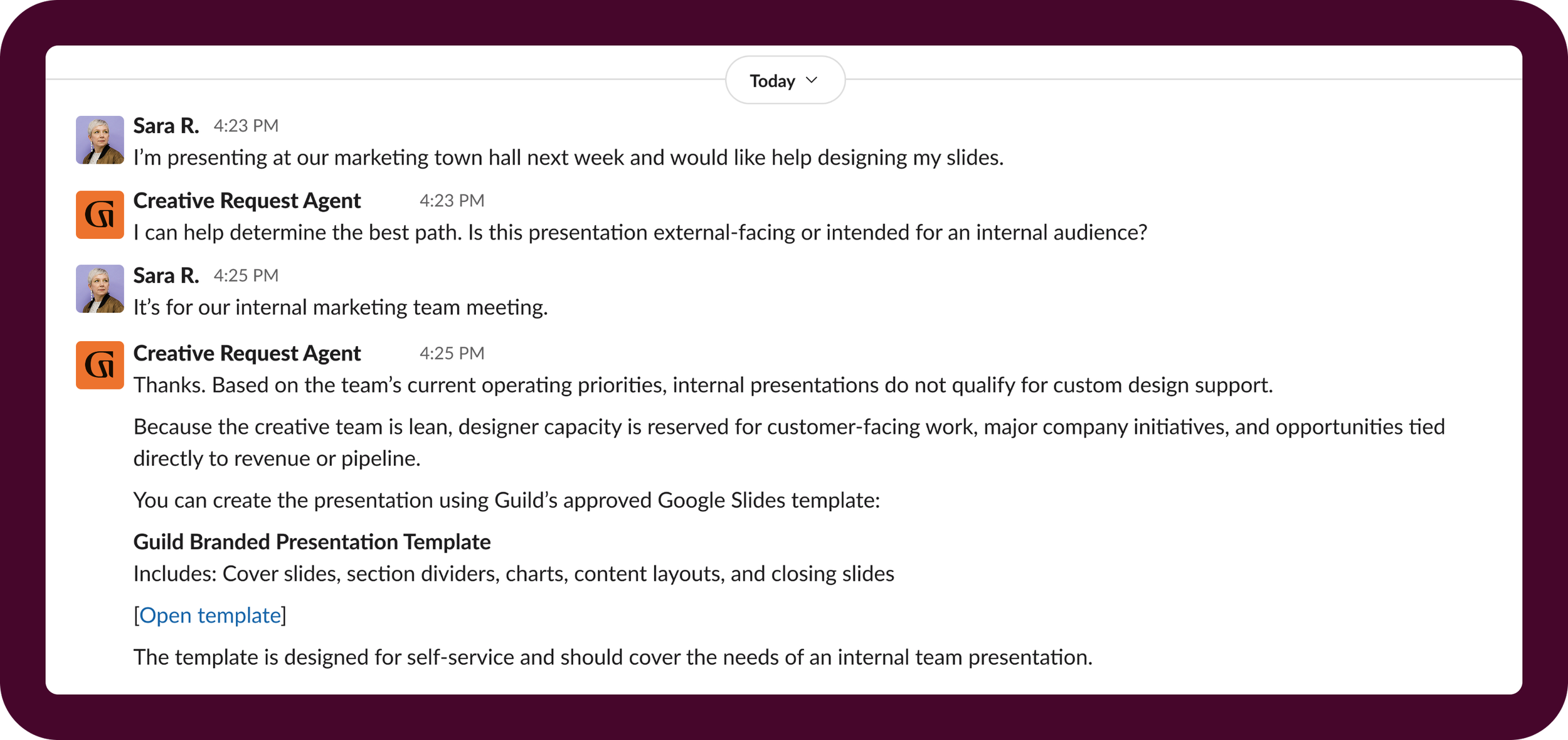
Intelligent Routing: Instead of default-assigning every request to a designer, the agent determines if the task can be completed without the support of a human, or if it’s even a priority for the business to warrant full time creative support.
Example: A marketer was presenting in an internal team meeting and requested support designing their slides. The agent informed the marketer that, given the lean size of the team, designers need to remain focused on customer-facing, revenue-driving opportunities. Instead, the agent sent the marketer Guild’s branded slide deck template so that they could self-serve this request.
System Auditing: It automatically scans Asana and Google Drive to see if a parallel asset already exists before recommending a path.
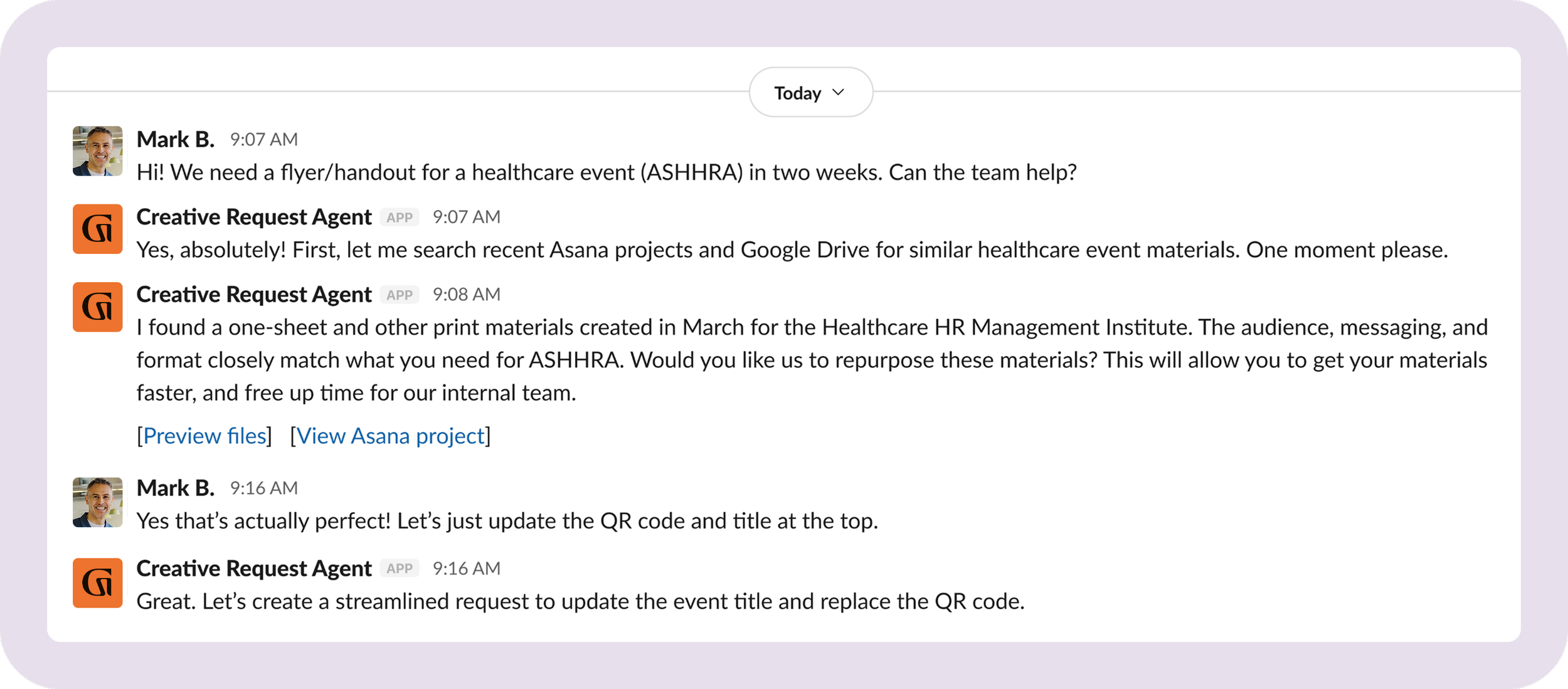
Example: A sales rep reached out asking for print assets to support an upcoming healthcare event. The agent scanned past Asana tasks and deliverables on Google Drive and discovered that the creative team had delivered almost identical assets for the events team who were attending a similar healthcare event two months ago. Instead of writing and designing something from scratch, the team just needed to update the title and swap the QR code.
CASE STUDY
Scaling Product Storytelling with AI Voice
The Challenge
Guild set out to create product overview videos for Academy, Grow, and Navigator. Each video also needed shorter 60- and 30-second cuts, along with industry-specific versions for audiences such as healthcare, financial services, and manufacturing.
What began as three videos quickly became dozens of distinct versions, each with slightly different scripts.
For a small number of films, hiring a professional voiceover artist would have made sense. At this scale, the cost of talent, recording sessions, usage, and repeated pickups would have grown quickly. Guild’s product storytelling needs had expanded faster than the available production budget, making a traditional voiceover model difficult to sustain.


The Solution
Rather than reduce the number of videos or compromise the versioning strategy, I used ElevenLabs to create a consistent synthetic voice across the entire system.
The goal was not simply to generate narration more cheaply. The voice still needed to feel natural, polished, and consistent across every product, duration, and audience.
ElevenLabs gave us the flexibility to support the full scope of the project without multiplying talent costs every time a script changed or a new version was added.
Take a listen to the voiceover in one of the videos here.
The Process
The work went far beyond simply pasting in a script and exporting the first result.
I generated multiple takes, adjusted pacing and emphasis, refined pronunciation, and reviewed each line for natural rhythm and inflection. In some cases, I worked word by word until the performance felt right.
This approach also made the system much easier to update. When a script changed, I could generate a new pickup immediately rather than scheduling another recording session. Industry-specific language and alternate cuts could be produced without creating new talent costs each time.
AI generated the voice, but the direction, judgment, and quality control remained human.
Project Goals
Create a polished, consistent voice across three product stories
Support 90-, 60-, and 30-second edits
Produce industry-specific versions without multiplying production costs
Make last-minute script revisions and pickups easier to manage
Preserve the full creative scope despite a limited voiceover budget
Maintain natural pacing, pronunciation, tone, and performance quality
Impact
The system allowed Guild to produce and update dozens of tailored video variations that would have been difficult to afford through a traditional recording model.
Based on professional non-broadcast voiceover benchmarks, the full set of scripts, alternate versions, and pickups would likely have cost between $4,500 and $9,000. ElevenLabs reduced the direct voiceover expense to approximately $6 a month, avoiding an estimated 99% or more of the talent cost.
More importantly, the project proved that lower cost did not have to mean lower standards. With close creative direction, AI voice made an ambitious production system financially possible while preserving the consistency and quality of the final work.